
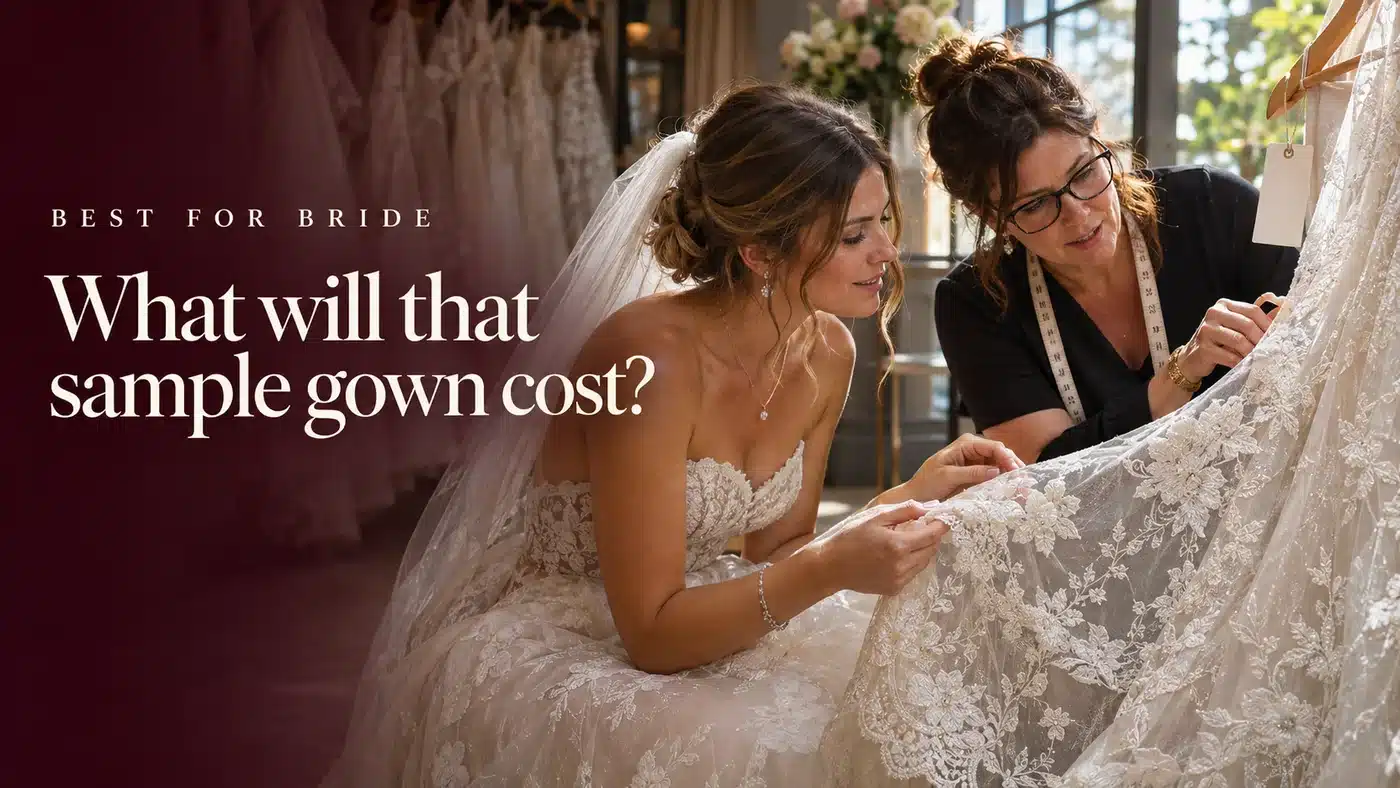
There’s a little grey mark near the hem of the dress you love. If your hem comes up two inches, that mark might leave with the offcut. If the lace edge has to stay, the mark might stay with it. That’s a good moment to put the price tag down and ask for a pin.
From our fitting room: Best for Bride’s tip on checking a marked hem.
To work out what a sample wedding dress will cost, add the gown price to the work this particular dress needs before you can wear it. Do the same for your next favourite. The difference between those two totals tells you how much you’ll actually save. An old retail price can’t do that calculation for you.
Take the two-gown cost worksheet to your appointment.
Table of Contents
Which gown are you buying?
Start with one question: “Is this the exact dress I’d be taking home?” A floor sample is a gown the shop has used for try-ons. A clearance rail may also hold new stock. Two dresses on the same rail can have quite different histories. Ask which pieces come with yours, especially if you tried it with detachable sleeves, a belt or an overskirt.
At Best for Bride, our clearance gown page lists selected dresses from $499 CAD. That’s a starting price for the gown. The store can confirm what’s available for your appointment. If this is your first sale, our sample and clearance sale guide explains how the shopping appointment works.
Choose a real comparison gown. If you’d happily get married in the $1,300 dress you tried on ten minutes ago, use that one. The $3,000 dress you admired in the window and would never buy makes almost anything look like a bargain.
What to check while the dress is on
Stand in shoes close to your wedding heel height and ask the consultant to show you where the finished hem would fall. Then get close enough to see the dress inside and out. If photos are allowed, take one from a few steps back and one close up. A close-up of a loose bead is surprisingly hard to place later among several hundred perfectly good beads.
| What you see | What to ask |
|---|---|
| A mark on the hem | Best for Bride’s sample-gown advice. Ask the fitter to pin the finished hem before you pay to clean a mark near the floor. If the marked fabric will be cut away, you can leave that spot off the estimate. If the lace border will be sewn back on, show the cleaner the mark. Link to this Best for Bride tip. |
| A gap in the beadwork | “Are matching beads included, and who would sew them on?” Ask to see a replacement beside the originals. A close colour match can look different under a camera flash. |
| A zipper that stops short | Ask the consultant to check the closure with the dress off your body. A damaged zipper and a bodice that needs more room call for different work. Have the fitter assess the seam allowance before counting on extra room. |
| A train that gathers on the floor | Ask whether the gown already has a bustle and have someone fasten it. If you need one added, put it on the alterations estimate for each gown that needs one. |
Now try sitting and walking. A dress that only fits when the clips are doing all the work deserves a second look. Our chair, stride and first-dance tests can help you show a fitter exactly where it pulls.
How a $400 price difference becomes $85
Say you love a $900 sample and a $1,300 gown. Both need a hem. The sample also needs a bead repair and cleaning. Here’s how the comparison could look once you have estimates.
| Cost | Sample gown | Other gown |
|---|---|---|
| Gown | $900 | $1,300 |
| Fit alterations and hem | $315 | $230 |
| Bead repair | $80 | $0 |
| Cleaning before wear | $150 | $0 |
| Estimated total | $1,445 | $1,530 |
These are invented figures to show the arithmetic. They are neither store quotes nor average Ontario prices. The second gown needs no repair or cleaning in this example. Check both dresses and compare quotes on the same tax basis.
The sample starts $400 ahead. It needs $315 more work than the other dress, leaving you $85 ahead. Now suppose the fitter spots a torn loop that wasn’t in the estimate. At $40 to repair it, the sample still saves $45. At $100, the sample costs $15 more.
How much room do you have for an unknown repair?
Subtract the sample’s known total from the other gown’s total. Here, $1,530 minus $1,445 leaves $85. At $85, the two cost the same. Write “quote needed” beside an unknown cost so it doesn’t quietly turn into a zero.
A bride planning a small ceremony bought a non-refundable sample and learned at her alterations appointment that the work would add another 60% to what she had paid for the gown. A reader asked whether she could take it to a different tailor. She had already tried that, and the second quote matched the first. Before you commit to a final-sale sample, write down the changes you need and ask for an estimate on that gown. It’s easier to compare two dresses while you can still choose either one. The bride’s budget and her follow-up about the second quote.
What to ask the fitter and the cleaner
Bring the actual gown, if the shop allows it, or ask whether a fitter can look at it before you buy. “How much to hem a wedding dress?” is hard to answer. “What would you charge to shorten these layers and put this scalloped border back at the bottom?” gives the fitter something specific to assess. Our alterations service offers a separate assessment for gowns bought here or elsewhere.
Ask which work the quote covers. If it already includes securing the lace at the side seam, leave that repair out of the separate repairs line. If you’d love to add sleeves but would wear the dress without them, price them separately. You can decide later whether they’re worth it.
For cleaning, show the mark and the care label to the person doing the work. Ask what result they expect, whether the estimate covers just that area or the whole dress, and whether cleaning should happen before the fitting. Ask specifically for gown cleaning before wear. Boxing a gown after the wedding is a different job. If the mark might remain, look at the dress again from ceremony-photo distance and decide whether you’d buy it as it is.
When is the sample worth buying?
If the sample fits your budget, you like it in its current condition, and the work can be finished before you need it, the discount is doing its job. A modest saving may be plenty if this is the dress you prefer. The date matters too. An in-stock gown can spare you a production wait, but the seamstress still needs an opening. Ask for a pickup date that works with your travel plans.
If your decision hangs on a seam being let out, a spot disappearing or a matching piece arriving, pause long enough to get an answer. Before paying, ask the shop to write down what’s included, who is responsible for each repair, and the sale and return terms for this gown. One useful question to finish with is “If I picked it up exactly as it looks today, what would still keep me from wearing it?”
Nayri, bridal stylist at Lovella Bridal, explains who a sample gown can suit and what to look at before you decide.
Your two-gown cost worksheet
Give each gown a name you’ll recognise tomorrow, such as “scalloped hem” or “plain satin.” Enter the same items for both. Add each column yourself and leave a note about any work still waiting on a quote. You can fill in the PDF on your phone or print one page and take a pen.
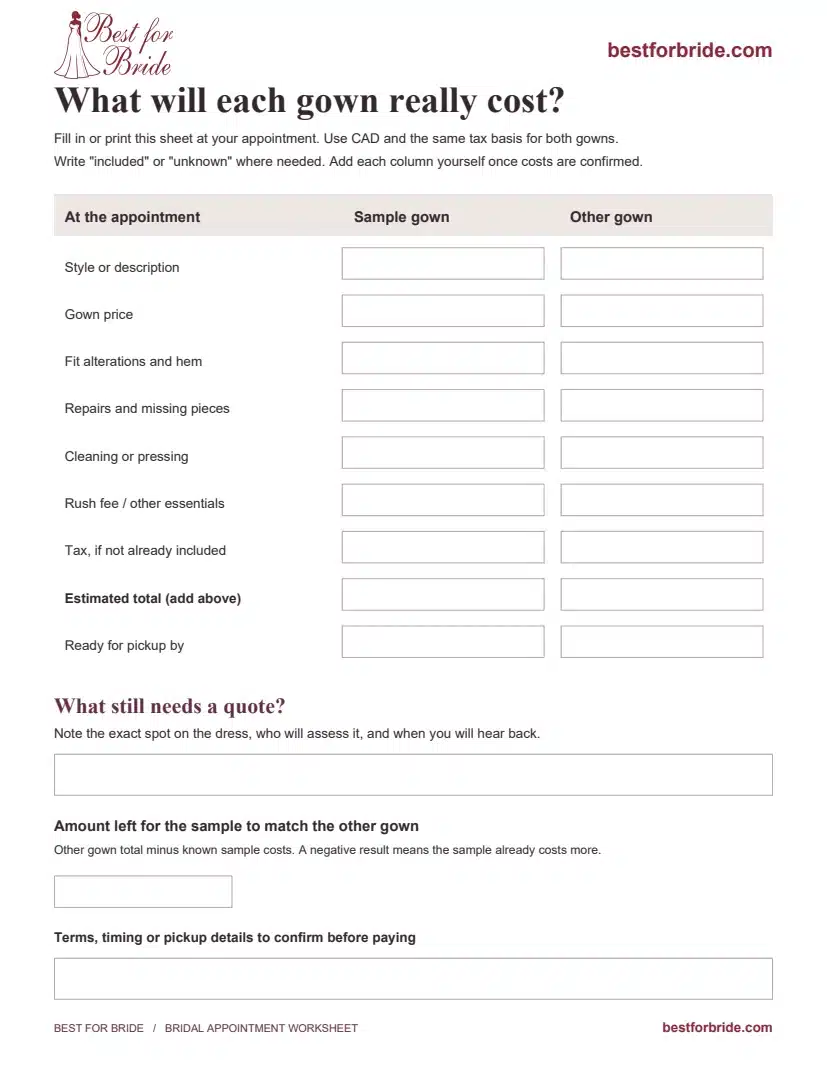
The worksheet opens in a new tab. You can fill in the boxes and save a copy, or print a blank sheet for your appointment.


