
You’ve probably seen it happen. A friend gets engaged, shows you her ring, and at first glance it looks like a beautifully classic design. Then she tilts her hand, catches the light differently, and suddenly you spot it. A single pink stone tucked into the setting, small enough that you’d miss it in a photograph but distinctive enough to change everything about how the ring reads. Many brides love the timeless quality of a classic engagement ring, and many also want a detail that makes the piece unmistakably theirs. The single pink accent has become one of the most popular ways to achieve exactly that, adding character and quiet individuality without stepping away from the traditional silhouette that drew you to the classic direction in the first place.
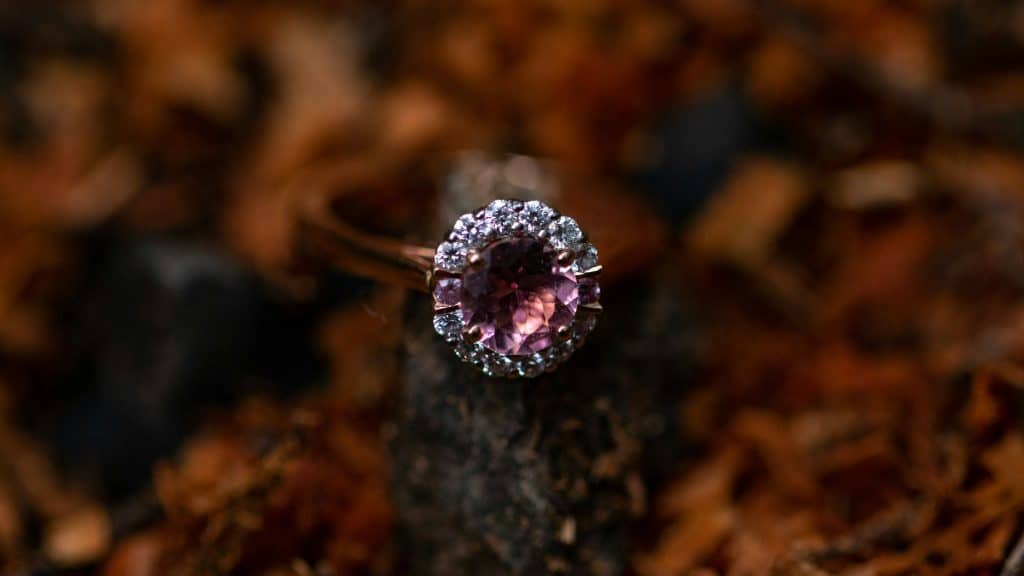
Table of Contents
The appeal of the classic engagement ring
Classic engagement ring styles have held their place across generations for good reasons. The solitaire, the three-stone, the halo, and the simple pavé band all share a visual language that feels familiar, considered, and timeless. There’s a reliability to the classic design that appeals to couples who want a ring they’ll still love in thirty years, not one that reads as of-the-moment and dates quickly.
Classic silhouettes photograph beautifully across decades, which matters for a piece worn every day and captured in countless images from the proposal through anniversary celebrations. They suit a wide range of hand shapes, finger lengths, and personal styling. They sit comfortably alongside future wedding bands and eternity rings, giving you flexibility in how the stack evolves over time. And they carry a sense of continuity with generations of engagement rings that came before, which many couples find meaningful.
The couples returning to classic silhouettes today often want something more than a straight replica of a mid-century ring. They want the timeless form, and they want a single distinguishing detail that makes the piece unmistakably theirs. The pink accent has become one of the most considered ways to achieve that.
What a pink accent actually does to the design
The visual effect of a single pink diamond against a field of white stones and precious metal is more significant than the size of the accent suggests. Pink catches light differently to white, with the colour drawing the eye in a way that a colourless stone in the same position simply doesn’t. Because the accent is small, it doesn’t dominate the composition. It punctuates it. The classic silhouette remains the primary form, and the pink stone becomes the detail that reveals itself slowly, rewarding closer looks and lingering glances.

The emotional register of the ring shifts too. A traditional white diamond arrangement reads as classic and considered. Adding a single pink stone brings warmth, femininity, and a sense of personal choice that a purely white composition can lack. The ring feels chosen rather than defaulted into, even when the overall silhouette is one of the most established shapes in the category.
Common placement options give you real flexibility. A pink accent can sit at the centre of a halo, be hidden beneath the centre stone in the gallery so it’s visible only from the side, be set into the shoulders of the band as small flanking stones, or appear as one of three stones within a trilogy arrangement. Each placement changes the character of the piece while keeping the classic form intact.
Where pink accent diamonds come from
Understanding where natural pink diamonds actually come from matters when you’re choosing one, even in accent size. The Argyle mine in the East Kimberley region of Western Australia produced more than ninety percent of the world’s natural pink diamonds during its operational years, and the mine closed permanently in 2020. Every natural Argyle pink diamond available today comes from the finite supply that was extracted before that closure. No new stones are entering the market from the source that produced them.

This gives a pink accent stone genuine provenance and rarity that goes well beyond its visual character. When you choose an Argyle pink diamond for even a small accent placement, you’re setting a stone with a specific and traceable history. The distinction between natural Argyle stones, lab-grown pink diamonds, and treated pink diamonds is significant and worth understanding. Certification confirms the origin and authenticity of the stone, and couples increasingly ask about documentation when a pink accent is part of the design. The Argyle certificate has become a meaningful piece of paperwork in this space.
How pink accents work across ring styles
The pink accent works beautifully across a range of classic silhouettes. Solitaire settings with a hidden pink accent tucked beneath the centre stone in the gallery are among the most popular current styles, with the pink revealed only when the ring is viewed from the side. The wearer knows it’s there, the meaning stays intimate, and the ring reads as a classic solitaire from every other angle.
Halo designs adapt naturally to a pink centre or a pink hidden accent, with white pavé surrounding a pink centre or a pink stone set into the halo band itself. Three-stone arrangements offer another elegant option, with a pink stone flanking a white centre or a white centre flanked by pink accents. Vintage-inspired settings suit pink accents particularly well, with the colour sitting beautifully within Art Deco geometry, Edwardian filigree, and Victorian cluster designs. Modern minimalist rings can be transformed with a single pink stone punctuating an otherwise completely plain band. A pink kimberly ring design shows how the accent stone can be worked into a wide range of classic silhouettes while retaining the timeless character of each style.
Practical things to consider
A few practical points are worth working through before committing. Certification matters for the pink stone, with Argyle documentation confirming origin and adding meaningful value to the piece both practically and archivally. Colour grading conventions for pink diamonds differ from those used for white diamonds, so understanding the tier system helps when comparing options. Setting choice affects how well the accent is protected over decades of wear, which matters more for smaller stones that could work loose if the setting is compromised.

Metal choice interacts with the pink tone in significant ways. White gold and platinum sharpen the colour and give a cooler read. Yellow gold warms the appearance of the pink and softens it. Rose gold complements pink accents especially well, echoing the tone while adding warmth to the overall composition. Budget considerations are real, since even a small pink accent can meaningfully affect the price of the ring given the stone’s finite supply. Where possible, seeing pink diamonds in person tells you more than any photograph can about how the colour actually reads.
- A single pink accent transforms a classic engagement ring by adding warmth and personal character without changing the timeless silhouette
- Natural pink diamonds come almost entirely from Western Australia’s Argyle mine, which closed in 2020 and gives every remaining stone genuine finite supply status
- Placement options include hidden accents beneath the centre stone, halo centres, band shoulders, and trilogy arrangements
- Certification, colour grading, setting protection, and metal pairing all matter when choosing a pink accent diamond for a classic ring


