
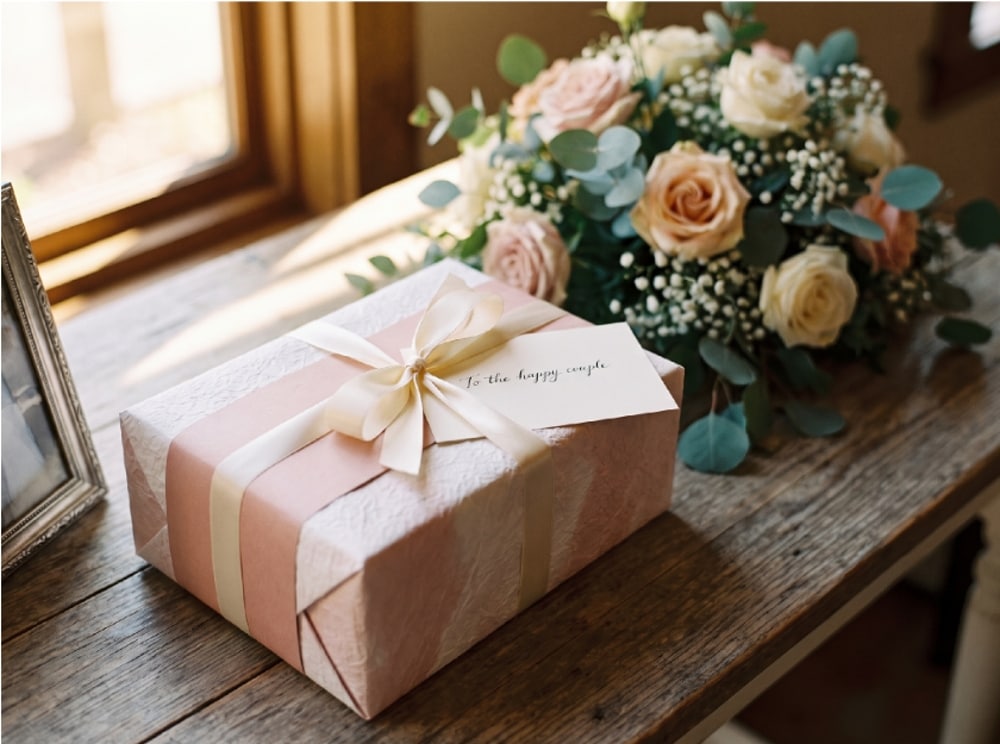
You just opened the invitation, and now the real question hits: how much should you actually spend on this gift? Every guest hits this wall eventually, whether it’s a coworker’s bridal shower or a cousin’s wedding. Spend too little and you worry about looking cheap. Spend too much and you’re stretching a budget for someone who’ll never know the difference.
The good news is that gift-giving etiquette isn’t a mystery, even though it can feel like one. There are real benchmarks, real data, and real rules that take the guesswork out of it. This guide walks through what guests are actually spending in 2026, the etiquette questions that trip people up most, and why some of the most memorable gifts aren’t the most expensive ones at all.
How Much Should You Spend on a Wedding or Bridal Shower Gift?
There’s no single “correct” number, but the data gives a workable range. Zola’s 2026 First Look Report, which surveyed more than 11,500 couples, put the average wedding gift spend at $130. Other 2025-2026 sources land close by: Bankrate’s 2025 survey found guests averaging around $120, while The Knot’s 2024 figures skewed slightly higher at roughly $150. Put those together and you get a realistic band of $120 to $150 for most weddings, with closer friends and family often landing at the top of that range.
One number that guests frequently misread is the cost of hosting. The Knot Worldwide’s 2026 Real Weddings Study, based on 10,474 US couples married in 2025, found that couples spent an average of $292 per guest to host their wedding, up $8 from the year before. That figure gets mentioned a lot in etiquette conversations, but The Knot Worldwide is explicit that it isn’t meant as a “cover your plate” guideline. Your gift is a gesture of goodwill, not a bill you’re settling for the open bar.
Bridal showers work on a smaller scale. Guests typically spend $50 to $75 per gift for a shower, since it’s usually a smaller, more intimate event than the wedding itself.
For guests who want the gift to feel personal rather than purely transactional, more people are turning to keepsakes built around a shared memory instead of another item off the registry. Ordering creative gifts from your own photos turns a couple’s favorite snapshot, maybe their engagement photo or a candid from a trip together, into wall art they’ll actually want to hang up, and it lands squarely within that $120 to $150 range guests are already comfortable spending.
Gift Etiquette Every Guest Should Know

The rules around timing and obligation trip up even experienced wedding guests. If you can’t attend, you’re still expected to send something, though there’s more flexibility on amount and timing than most people assume. Traditionally, guests had up to a year after the wedding to send a gift, but sending it before or shortly after the event is more considerate and keeps things simple for the couple who’s tracking thank-you notes.

U.S. News & World Report’s etiquette coverage echoes a point worth repeating: you don’t owe the couple a gift equal to their per-plate cost. That “cover your plate” idea has circulated for decades, but etiquette experts consistently push back on it. A gift should reflect your relationship and your own budget, not the caterer’s invoice.
Cash has become the default choice for a reason. The Knot Worldwide’s 2026 Annual Registry Study found that 75% of couples now include a cash fund on their registry, and 56% combine traditional gifts with cash funds in a hybrid setup. Even more telling, 41% of couples say cash is the gift they most want. If you’re unsure what to give and the couple has a fund listed, that’s usually your safest bet.
Personalized and Sentimental Gifts Guests Never Forget

Cash is practical, but it isn’t always memorable. That’s where personalized gifts earn their reputation. A 2024 study published in Psychology & Marketing by researchers from the University of Bath, SKEMA Business School, and EM Lyon Business School found that personalized gifts trigger what they call “vicarious pride” in recipients, making people feel more valued than they would with an equivalent non-personalized item. The researchers noted this effect holds even when the underlying product is identical; the personalization itself is what shifts perceived thoughtfulness.
That explains why engraved cutting boards, custom photo calendars, and memory books consistently outperform generic registry items in surveys about which gifts couples remember years later. The photo-based keepsake mentioned earlier fits this exact pattern: it takes something the couple already loves, a photo they chose themselves, and turns it into something they’ll display rather than store in a closet.

Bridal Shower Gifts vs. Wedding Gifts: What’s the Difference?
Guests often assume the same rules apply to both events, but they don’t. A bridal shower is smaller and more personal, often organized around a theme or specific need, like kitchen essentials or lingerie. It’s also more common to bring something playful or lighthearted for a shower, since the mood tends to be looser than a wedding reception.
Wedding gifts, by contrast, lean more toward the registry or cash fund, since the couple is setting up a shared household or covering costs tied to a much bigger event. If you’re picking a shower gift, our piece on matching the shower gift to the couple’s wedding theme walks through how to make it feel intentional without guessing.
Practical Tips for Choosing the Right Gift on Any Budget
Budget tiers make this easier once you break them down by relationship. Coworkers and casual acquaintances typically spend $50 to $75. Friends and extended family usually land in the $100 to $150 range. Close family, like siblings or parents, often go higher, sometimes $200 or more, especially if they’re also contributing toward the wedding itself.
If a specific registry item feels out of reach on your own, group gifting solves that problem well. Splitting a bigger-ticket item with two or three other guests lets you give something meaningful without stretching your budget past what’s comfortable. It’s especially useful for big-ticket appliances or furniture pieces that no single guest wants to cover alone.
Whatever tier you fall into, planning matters more than spending. A 10 steps to planning the perfect bridal shower mindset applies just as much to gift shopping as it does to hosting; start early, and you’ll avoid the last-minute panic of grabbing whatever’s left on the registry.

Conclusion
The dollar amount matters less than most guests think. What actually gets remembered, years down the line, is whether the gift felt thoughtful. A $130 average spend is a fine benchmark to aim for, but a well-chosen $80 keepsake will outlast a $200 appliance in the couple’s memory almost every time.
Trust the etiquette basics: give what fits your budget and relationship, skip the “cover your plate” math, and lean toward something personal when you can. That’s the gift people talk about at the next family dinner, not the one that just checks a registry box.


